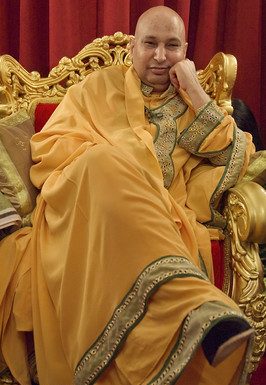
The best way to remove your weaknesses is not to think about them; otherwise you will be overwhelmed. Bring the light in and you will,,,
“”””””””””””””””””””””””””””””””””””””””
Deny karma. Too many people misinterpret the meaning of karma, adopting a fatalistic attitude. You do not have to accept karma. If I tell you that somebody is standing behind you ready to hurt you because you once hit him, and you meekly say, “Well, it is my karma,” and wait for him to strike you, of course you will get a blow! Why don’t you try to mollify him? By pacifying him you may lessen his bitterness and remove his desire to strike you.
When you realize yourself as a child of God, what karma have you? God has no karma. And you have none, when you know you are His child. Every day you should affirm, “I am not a mortal being; I am not the body. I am a child of God.” That is practicing the presence of God. God is free from karma. You are made in His image. You also are free from karma.
The best way to remove your weaknesses is not to think about them; otherwise you will be overwhelmed. Bring the light in and you will feel that darkness never was. In that thought is one of the greatest inspirations of my life. If light is admitted into a cave where darkness hás existed for thousands of years, darkness will vanish instantly. So will our faults and weaknesses vanish when we bring in the light of God. The darkness of ignorance can enter nevermore.
Sri Sri Paramahansa Yogananda.
Journey To Self-realization. P.409-410.
[Realizing God in Your Daily Life]
Real discrimination.
To be free from bondage, the wise person must practise discrimination between One-Self and the ego-self. By that alone you will become full of joy, recognising Self as Pure Being, Consciousness and Bliss.
~Adi Shankaracharya.
Universal consciousness.
Q: Why is it that we naturally seem to think of ourselves as separate individuals?
Sri Nisargadatta Maharaj:
Your thoughts about individuality are really not your own thoughts;
they are all collective thoughts.
You think that you are the one who has the thoughts;
in fact thoughts arise in consciousness.
As our spiritual knowledge grows,
our identification with an individual body-mind diminishes,
and our consciousness expands into universal consciousness.
The life force continues to act, but its thoughts and actions are no longer limited to an individual.
They become the total manifestation.
It is like the action of the wind
—
the wind doesn’t blow for any particular individual, but for the total manifestation.
Excerpt from the book: I am That.
Surrender
Surrender is a practical proposition. It releases the devotee from life’s dilemma. Wherever Sri Krishna teaches about saranagati in the Bhagavad Gita he refers to ananya bhakti, where the instrument and the goal are one and the same. The same idea is stated by Sri Bhagavan in the fifth verse of “Arunachala Pancharatnam”:
One who surrenders his heart wholly to you, one who sees you in every aspect of creation, one who loves every creation as himself – he is the one who will succeed,
O Arunachala! he will get immersed in you!
Here Sri Bhagavan stresses ananya bhakti and self-surrender.
It is interesting to note that Sri Krishna says, “Do not grieve.” After surrendering yourself totally to God, you should not even worry about your own shortcomings or flaws. For if you think you have to improve yourself after surrender, then it indicates a residual ego in you. Hence, don’t grieve about your flaws after surrender. It only shows your surrender is incomplete.
Bhagavan says after getting into a train, nobody carries the luggage on his head. He keeps it on the luggage-rack.
Likewise, after surrendering, do not continue to carry your mental luggage. Leave it totally to His care.
After surrender you should not have
1) worries, 2)Surrender fear, 3) doubt,
4) sorrow, 5) the inclination to test whether
surrender is effective or not and
6) aberrations (conflicts).
The devotee who has surrendered is like a lump of clay in the hands of the potter.
The lump never says,
“Make me a pot! Make me a cup, etc.”
It leaves it to the potter to mold it into whatever shape he wants it to become.
Sri Bhagavan lays great value on ananya saranagati. There are several instances where He explains the concept to the questioner:
“If you have surrendered, it means that you must accept the will of God and not make a grievance of what may not happen to please you. Things may turn out differently from what they appear. Distress often leads people to faith in God.
“The Lord bears the burden of the world. Know that the spurious ego which presumes to bear that burden is like a sculptured figure at the foot of a temple tower which appears to sustain the tower’s weight. There cannot even be impatience for speedy realization.”
To one who was so afflicted, he replied: “Surrender to Him and accept His will whether He appears or vanishes. Await His pleasure. If you want Him to do as you want, it is not surrender, but command. You cannot ask Him to obey you and yet think you have surrendered. He knows what is best and when and how to do it. Leave everything entirely to Him. That is what is meant by surrender.”
Even prayer can imply a lack of trust and Sri Bhagavan normally did not encourage prayer in the sense of petition:
“They pray to God and finish with
‘Thy will be done’.
If His will be done, why do they pray at all?
It is true that Divine Will prevails at all times under all circumstances. Individuals cannot act of their own accord. Recognize the force of the Divine Will and keep quiet. Everyone is looked after by God. He created all. You are only one among two thousand millions.
When He looks after so many, will He omit you?
Even common sense dictates that one should accept His will. There is no need to tell Him your requirements. He knows them Himself and will look after them.”
To a devotee’s question Sri Bhagavan replied:
“Gandhiji has surrendered himself to the Divine and works accordingly with no self interest. He does not concern himself with the results but accepts them as they turn up.
That must be the attitude of national workers.
“Devotee: Will the work be crowned with success?
“Bhagavan: The question arises because the questioner has not surrendered himself.”
When a devotee questioned about unconditional surrender, Bhagavan replied:
“If one surrenders completely, there will be no one left to ask questions or to be considered. Either the thoughts are eliminated by holding on to the root thought “I”, or one surrenders unconditionally to the Higher Power. These are the only two ways to Realization.”
~ Maharshi’s Newsletter
# NOV/DEC 2002 VOL. 12, NO. 6
Great commune with God.
Each one has to win own victory. Make up your mind that you are going to be supremely victorious. You don’t need an army or,,,
“”””””””””””””””””””””””””””””””””””””””””” Waste no more time, for if you have to change your bodily residence you will have to wait a long time for another opportunity to seek God earnestly, passing first through rebirth and the travails of childhood and the restlessness of youth. Why squander your time in useless desires? It is foolish to spend your life seeking things you must forsake at death. You will never find happiness that way. But every effort you make toward the contact of God in meditation will bring you an everlasting gift of the soul. Start now—those of you who are real lovers of God, seeking not your own glory, but the glory of Spirit.
Each one has to win his own victory. Make up your mind that you are going to be supremely victorious. You don’t need an army or money or any other material help to gain the highest victory attainable; just a strong determination that you are going to win. All you have to do is sit still in meditation, and with the sword of discrimination cut off, one by one, the advance of restless thoughts. When they will all be dead, God’s kingdom of calm wisdom will be yours.
Every one of you who has heard this sermon, and who makes a sincere effort to change, will find a greater communion with God, and in Him the true and lasting victory of the spirit.
Sri Sri Paramahansa Yogananda.
The Divine Romance. P.400-401.
[How to find a way to victory]
Self realization-only through intellect.
The gross body
made up of the five gross elements
(earth, water, fire, air and ether)
is meant to reap the fruits of past actions in the shape of pleasure and pain.
The subtle body
consisting of the five airs, the mind,
intellect, the ten senses and
made up of subtle elements is also meant for enjoyment (as in dreams).
Inexpressible and beginningless ignorance is said to be the causal body
(as in deep sleep).
Know the Self to be other than these three upadhis.
Just as a clear crystal (itself colourless) appears red, blue, yellow, etc.,
according to the background,
so also the Self,
pure and untainted,
seems to be identical with the body,
the senses, the mind, intellect or blissful ignorance (panchakosas) when in contact with them.
Just as husking the paddy exposes the grain within (the rice),
so also should one judiciously separate the pure Atman from the sheaths covering it.
Though always and everywhere present, the Self does not shine forth in all places. Just as light is reflected only in a transparent medium, so also the Self is clearly seen in the intellect only.
The Self is realized in the intellect as the witness of the activities of,
and yet separate from the body, the senses,
the mind, intellect and gross nature (prakriti) as is a king in relation to his subjects.
🕉 Sri Adi Shankaracharya.
✅ Atma Bodha. Verses 12-18.
Strive to remain with God alone.
Q.: “Sir, why are we in bondage like this? Why do we not See God?”
Sri Ramakrishna: “Man’s ego itself is Maya. It is the veil that shuts out the Light. Verily, with the death of the “I” all troubles cease. If by the grace of the Lord a man once gains the knowledge that he is not the doer, then he assuredly becomes a Jivanmukta, one freed in this very life, and transcends all fear”.
“There are few, who can attain Samadhi and get rid of the Aham ― the feeling of “I” within. Generally it does not go. You may reason and discriminate without end, yet this “I” comes back again and again. Today you may cut down the Peepul tree, but tomorrow you will see it sprouting again”.
“If one ponders over this word “I”, trying to track it down, one sees that it is only a word, which denotes egotism. But it is extremely difficult to shake it off. So one must say: “You wicked “I”, if you will not go by any means, remain as the servant of God”. The ego, that feels itself to be the servant of God, is called the “ripe I””.
“If you feel proud, let it be in the thought that you are the servant of God, the son of God. Great men have the nature of children. They are always children before Him; so they are free from pride. All their strength is of God, and not their own. It belongs to Him and comes from Him”.
Bhagavan Sri Ramakrishna
(“Sayings of Sri Ramakrishna”, Sri Ramakrishna Math, Mylapore, Madras, BOOK I Man and the World, Ch. IV, Maya as Ahamkara or Egoism, 101, 113, 119, 124)
Hold one trend of thought .
But as long as it exists for you, have but one trend of throught in your mind—God. If you seek Him earnestly, how can He resist your love?,,,
“””””””””””””””””””””””””””””””””””””””””
Do not take this life too seriously. It will be gone before you know it. When our childhood was there, life seemed so beautiful. There were so many things to want, so many things to enjoy with so little responsibility. But now see how life is. All those dreams are gone. In the same way, this episode in life will pass away. But as long as it exists for you, have but one trend of thought in your mind-God. If you seek Him earnestly, how can He resist your love? Constantly, inwardly, talk to Him; then He cannot remain away from you.
“Give my Mother a soul call; She can’t remain hidden anymore.” Close your eyes, think of God, and give the Divine Mother a call from your soul. This you can do any time, anywhere. No matter what else you may be doing, you can mentally converse with God: “My Lord, I am looking for You. I don’t want anything but You alone. I long to be with You always. You made me in Your image; and my home is with You. You have no right to keep me away from You. Maybe I have done wrong, tempted by delusions of Your cosmic play; but because You are my Mother, my Father, my Friend, I know You will forgive me and take me back. I want to go Home. I want to come to Thee.”
Sri Sri Paramahansa Yogananda.
Journey To Self-realization.
Saguna Brahman.
Nirupana 18
The feeling ‘I know a lot’ is ignorance. Once it is understood that this is pure ignorance, it does not matter whether one talks a lot or not at all. When you go to sleep, you are sleep itself. You are not separate from the sleep. On waking up, the knowledge ‘I am’ dawns upon you and instantly creates the world. When you are asleep, you are pure ignorance. What would happen if one day this ignorance does not wake up? Then who would be there to die? Ignorance sleeps and wakes up every day! What is the meaning of the removal of ignorance? You can take any meaning you like. But what is the real situation? You, who are awake, go to sleep. That means the knowledge itself becomes ignorance. You have to understand the true import of this fact. (Here, ignorance implies the Absolute, and knowledge implies the sense ‘I am’.)
When Brahman is liberated, Parabrahman stays as He is. That which is the cause of this itch (happiness and misery) is Brahman. When the itch disappears, it is Parabrahman. What I am, here and now, is awakened ignorance. The base for all things is ignorance that is called sleep. Wakefulness is the child of ignorance. If there is ignorance, only then there can be knowledge.
The faith that ‘you are’ is created in you. It has come uninvited. Faith or devotion means love. It is the love for the Self. The certitude that ‘you are’ is the pure and holy manifestation of Paramatman. It is jnana.
Recognition of the body comes through this faith in the Self. The holy names are for that certitude of the Self. Do not worship the impermanent i.e. the body. The use of this body is to nourish the faith in the Self. The fragrance of ‘I am’ coming through the body is God. One who believes he is the body faces death.
You have different kinds of beliefs. You become according to what you believe. How very powerful is the effect of beliefs! Be aware of that fact. Your faith that ‘you are’ is of the nature of the Guru or God. It is in your heart in the form of light (knowingness). The light of the Self never dies. One whose Self-light does not die, will he ever die? He may not live in today’s form, that is all. The form is illumined by this light. The sense ‘I am’ is God. It is called saguna-Brahman (the manifest with quality). It is contained in Parabrahman (the Absolute without quality). You are Brahman. The great mantra given to you is the expression of Brahman. It is your own nature. You must invoke It by the mantra. It will surely reveal Itself.
One who wins a big lottery becomes happy. He considers himself a rich man. It took only a moment for this to happen. If this is so, why does not the Guru’s mantra bring about such instantaneous change? With faith in the Guru, fear of death vanishes forever. Thereby the fear of birth also vanishes. As you nurse in your heart the faith of your beingness, your conduct will go on changing. The belief that ‘I am a meager human being’ changes to ‘I am Brahman’. Then the work is done. The Guru’s word is perfect knowledge. It is the state of Being – it is movement as well. Hold onto it tightly. All other means cannot even come close to it.
— Nisargadatta Maharaj
Sunday, March 26, 1978
Excerpt from: Meditation with Nisargadatta Maharaj
God’s plan
Everything works in mutual harmony with the Divine Plan.
We are a part of that universal scheme — just as important as the sun and the moon and the stars.
We have to do our part; we must play the role that is assigned to us by the Divine, not what we want to play.
When you use your own willfulness in opposition to the will of God, you spoil this drama.
You do not contribute your share to fulfill the great plan of this universe.
Why not say: “Let me do what God wants me to do.” I think you will be much happier, much more peaceful, much better off.
Paramhansa Yogananda
The Divine Romance
@everyone
🕉 🕉 🕉 🕉 🕉 🕉 🕉 🕉 🕉 🕉 🕉
सब कुछ ईश्वरीय योजना के साथ परस्पर सामंजस्य में काम करता है।
हम उस सार्वभौमिक योजना का हिस्सा हैं – सूर्य, चंद्रमा और सितारों की तरह ही महत्वपूर्ण।
हमें अपना काम करना है; हमें ईश्वर द्वारा सौंपी गई भूमिका निभानी है, न कि वह जो हम निभाना चाहते हैं।
जब आप ईश्वर की इच्छा के विरुद्ध अपनी इच्छाशक्ति का उपयोग करते हैं, तो आप इस नाटक को बिगाड़ देते हैं।
आप इस ब्रह्मांड की महान योजना को पूरा करने में अपना योगदान नहीं देते।
क्यों न कहें: “मुझे वही करने दें जो ईश्वर मुझसे करवाना चाहता है।” मुझे लगता है कि आप बहुत अधिक खुश, बहुत अधिक शांतिपूर्ण, बहुत बेहतर महसूस करेंगे।
परमहंस योगानंद
दिव्य रोमांस
 InnerRealisation